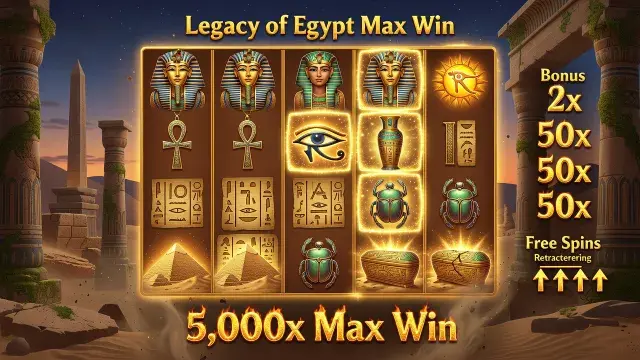
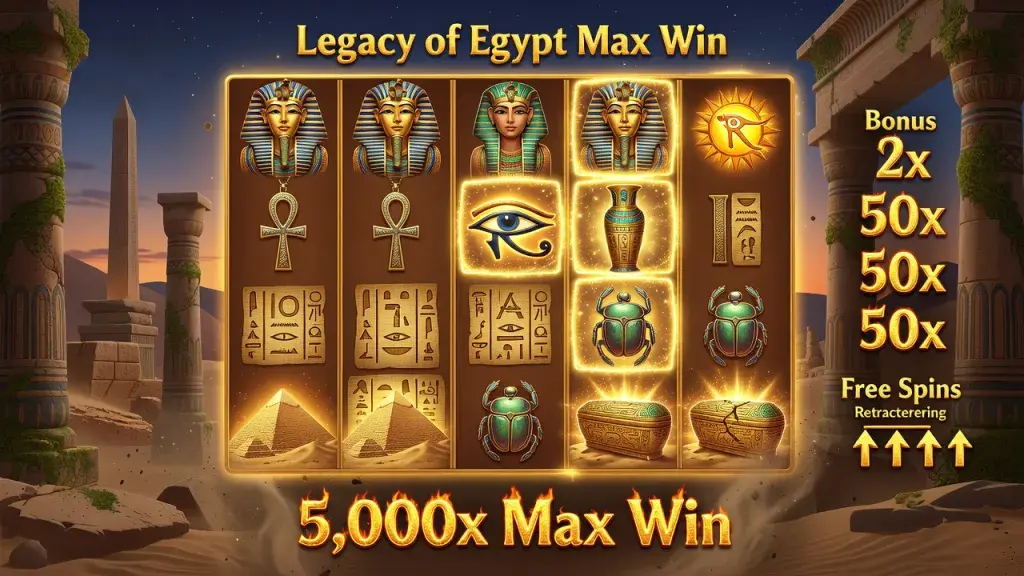
A single spin on an Egyptian-themed reel set can turn a modest stake into a payout worth thousands of times the original bet. That gap between what you risk and what you might collect is the entire reason this genre of slot has stayed popular for over a decade. Pyramids, scarabs, and pharaoh symbols are decorative - the real draw is the math sitting underneath them, and few titles illustrate that math as clearly as the legacy of egypt max win mechanic.
Most players approach an Egyptian-themed game expecting atmosphere first and payout structure second. That's backwards. The visual theme is interchangeable; what separates a mediocre slot from a genuinely rewarding one is how its bonus systems stack multipliers, free spins, and expanding symbols to produce outsized results. If you want to understand why some sessions on the egyptian legacy slot end in a small cashout and others end in a five-figure win, you have to look at the bonus architecture itself. For readers who want to see the mechanics in action rather than just read about them, the legacy of egypt max win page offers a direct look at how the numbers play out in real rounds.
This piece breaks down exactly how the maximum win potential is built, what triggers the biggest multipliers, and how to read the game's volatility before you commit a single coin.
Understanding the Legacy of Egypt Max Win Mechanic
The term "max win" refers to the theoretical ceiling a slot can pay out from one single spin or one triggered bonus round, expressed as a multiple of the total stake. In the case of the legacy of egypt max win structure, that ceiling is reached through a combination of stacked wilds, retriggered free spins, and an escalating multiplier that compounds across consecutive winning rounds rather than resetting after each one.
What "Max Win" Actually Measures
Max win figures are not average outcomes - they represent the rarest, most favorable sequence of events the game's random number generator can produce. A game advertising a 5,000x max win will pay that amount only under a specific, low-probability chain of triggers: full-screen symbol matches, consecutive multiplier increases, and often a bonus buy or free spin retrigger stacked on top of each other.
Why Egyptian-Themed Slots Favor High Ceilings
Developers gravitate toward Egyptian mythology because the symbol set naturally supports tiered value structures - scarabs, ankh symbols, and pharaoh masks slot neatly into low, medium, and high-paying categories. This tiered design makes it easier to build a math model where rare high-tier combinations justify a dramatically higher payout ceiling than the base game symbols would suggest.
How This Differs From Standard Slot Payout Models
A conventional slot without a compounding bonus structure typically caps its max win somewhere between 500x and 2,000x the stake. Titles built around the legacy of egypt theme frequently push past that range specifically because their bonus rounds are designed to stack multipliers rather than pay them out individually.
- Standard base-game wins: capped by fixed paytable values
- Free spin round wins: multiplied by a retrigger-based multiplier
- Bonus feature wins: compounded across multiple qualifying spins
The Egyptian Legacy Slot Theme and Symbol System
Theme consistency matters more than it appears to on the surface. In the egyptian legacy slot format, every symbol carries both a decorative and functional role - a scarab isn't just a scarab, it's a mid-tier payout trigger that also frequently doubles as a scatter for bonus entry.
Core Symbol Hierarchy
Low-value symbols are usually represented by card ranks (10 through Ace) styled in hieroglyphic fonts, while mid-tier symbols include items like canopic jars, ankh pendants, and eye-of-Horus icons. High-tier symbols - pharaohs, queens, and sun-god imagery - carry the largest base-game payouts and are the symbols most likely to appear in stacked formations during bonus rounds.
Wild and Scatter Behavior
Wild symbols in this genre typically substitute for everything except the scatter, and many versions include an expanding wild that fills an entire reel once triggered. Scatters, almost always represented by a pyramid or sarcophagus symbol, are the gateway to free spins and are the single most important symbol to track if you're chasing ancient egypt winnings.
Symbol Density and Its Effect on Hit Frequency
Games with a denser high-tier symbol distribution tend to produce more frequent, smaller wins, while sparser distributions push the game toward higher volatility - fewer wins overall, but a materially higher ceiling when a win does land. Reading the paytable's symbol frequency, when available, tells you more about realistic outcomes than the marketing max win figure ever will.
How the Max Win Bonus Feature Is Triggered
Every high-ceiling slot needs a gateway mechanic, and the max win bonus feature is exactly that. It's the specific in-game event - usually a scatter combination - that unlocks the sequence of free spins, multipliers, or pick-and-click rounds capable of producing the advertised maximum payout.
Standard Trigger Conditions
Most versions require three or more scatter symbols landing anywhere on the reels within a single spin. Some variants introduce a secondary trigger, such as filling a symbol collection meter across multiple spins, which adds a progression layer on top of the pure luck-based scatter trigger.
Retriggers and Their Compounding Effect
Once inside the bonus round, landing additional scatter symbols usually adds extra spins to the counter rather than starting a new round from scratch. This retrigger mechanism is critical - it's the primary reason bonus rounds can extend well beyond their initial spin count and accumulate multiplier value along the way.
Bonus Buy Options
Many modern titles in this category offer a direct bonus purchase option, letting players pay a fixed multiple of their stake to enter the feature immediately, bypassing the base game entirely. This doesn't change the underlying math or improve the odds of hitting the max win - it simply removes the wait, at a cost calculated to match the feature's average expected value.
- Natural trigger: 3+ scatters during base game play
- Progressive trigger: symbol collection meter across spins
- Purchased trigger: fixed-cost direct entry into the bonus round
Bonus Multiplier Egypt Slot Mechanics Explained
The multiplier system is where the real difference between a good win and a max win occurs. A bonus multiplier egypt slot design typically starts each free spin round at a base multiplier - often 1x or 2x - and increases it based on specific in-round events.
Incremental vs. Compounding Multipliers
An incremental multiplier increases by a fixed step (1x, 2x, 3x) with each qualifying event, capping at a predetermined ceiling, often between 10x and 50x. A compounding multiplier, by contrast, can double or triple with each trigger, which is exactly the mechanic responsible for the most dramatic max win outcomes in this genre.
Multiplier Carry-Over Between Spins
In the best-designed versions, the multiplier does not reset between free spins within the same bonus round - it carries forward and only increases. This single design choice is what separates a modest 200x win from a five-figure multiple of the stake, because a late-round big win benefits from every multiplier increase accumulated earlier in the sequence.
Symbol-Linked Multiplier Boosts
Some titles tie multiplier growth directly to specific symbols - landing a particular wild or bonus icon adds a fixed value to the running multiplier rather than relying purely on random escalation. This gives attentive players a way to gauge, mid-round, roughly how much multiplier potential remains available before the feature concludes.
Calculating Realistic Ancient Egypt Winnings
Advertised max win figures make for good marketing copy, but they say very little about what a typical session actually returns. Understanding return-to-player (RTP) percentages and volatility ratings gives a far more honest picture of expected ancient egypt winnings over time.
RTP as a Long-Term Indicator
RTP represents the theoretical percentage of all wagered money returned to players over millions of spins - commonly somewhere between 94% and 97% for this slot category. It says nothing about any single session, but it does indicate how generously the game is calibrated relative to its house edge.
Volatility and Session Length
High-volatility Egyptian-themed slots pay less frequently but with larger individual wins, meaning a session can run through many spins with little return before a single bonus round changes the entire outcome. Lower-volatility versions smooth that curve, delivering smaller, more frequent wins but a lower realistic ceiling.
Bankroll Management Around High-Ceiling Games
Because the max win scenario requires a rare confluence of triggers and multiplier growth, treating any single bonus round as a guaranteed payday is a mistake. A more disciplined approach sets a fixed loss limit per session and treats large multiplier outcomes as a bonus rather than an expectation.
- Check the listed RTP before playing for extended sessions
- Match volatility level to your bankroll size and risk tolerance
- Track bonus round frequency rather than relying on max win marketing figures
Strategic Tips for Maximizing Bonus Round Value
While no strategy overrides the random number generator, a few practical habits improve how effectively you extract value from the bonus rounds you do trigger.
Timing Your Bonus Buy Decisions
If a bonus buy option is available, compare its fixed cost against your remaining bankroll rather than against the theoretical max win. A bonus buy priced at 80x to 100x your base stake only makes sense if triggering it doesn't compromise your ability to keep playing afterward.
Reading Paytable Multiplier Caps Before Playing
Every properly licensed slot publishes its multiplier cap and bonus round structure in the in-game information screen. Reviewing this before committing real money tells you whether the game's realistic ceiling matches your expectations, rather than relying on promotional max win numbers alone.
Recognizing When a Session Has Peaked
After a large multiplier hit, many players chase a repeat performance in the same session, which statistically works against them since each spin remains independent. Recognizing a strong result as a natural stopping point protects the value of that win rather than risking it back into the game.
Frequently Asked Questions
What is the difference between a max win figure and the RTP percentage?
The max win figure is the highest possible payout from a single spin or bonus round under the rarest trigger sequence, while RTP is a long-term average return calculated across millions of spins. A slot can have a high max win and still return money to players slowly over time, since the two numbers measure completely different things.
Can the multiplier reset mid-bonus round?
It depends on the specific game design. Some titles reset the multiplier after every free spin, while higher-ceiling versions carry the multiplier forward and only allow it to increase throughout the bonus round, which is what enables the largest payouts.
Is buying the bonus feature a better strategy than waiting for a natural trigger?
Neither approach changes your statistical odds of hitting the max win, since the purchase price is calculated to match the feature's average expected value. Buying the feature simply removes the wait time and lets you skip base-game spins that might not trigger the bonus naturally.
Why do Egyptian-themed slots often advertise higher max wins than other themes?
The tiered symbol structure common to this theme - low, mid, and high-value hieroglyphic icons - lends itself well to compounding multiplier designs. Developers use this structure to build bonus rounds capable of stacking multiple multiplier increases, which pushes the theoretical ceiling well above standard slot averages.
Does a higher volatility rating always mean a bigger potential win?
Generally yes, but it also means longer stretches without a payout and a higher risk of exhausting your bankroll before a bonus round triggers. Matching volatility to your available bankroll and patience level matters more than chasing the highest advertised ceiling.
How can I tell if a bonus round is close to its multiplier cap?
Most games display the current multiplier value directly on screen during the bonus round, alongside the maximum cap listed in the paytable. Comparing the two in real time gives you a clear sense of how much additional multiplier growth remains possible before the feature ends.