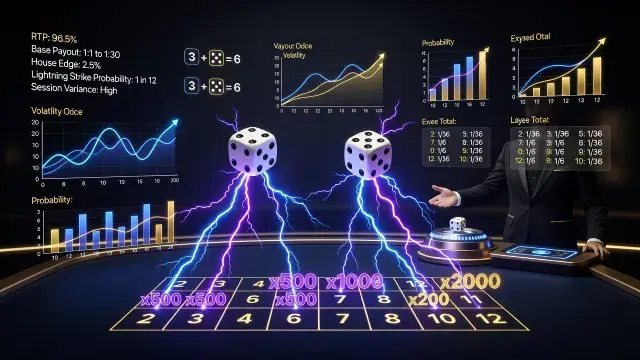
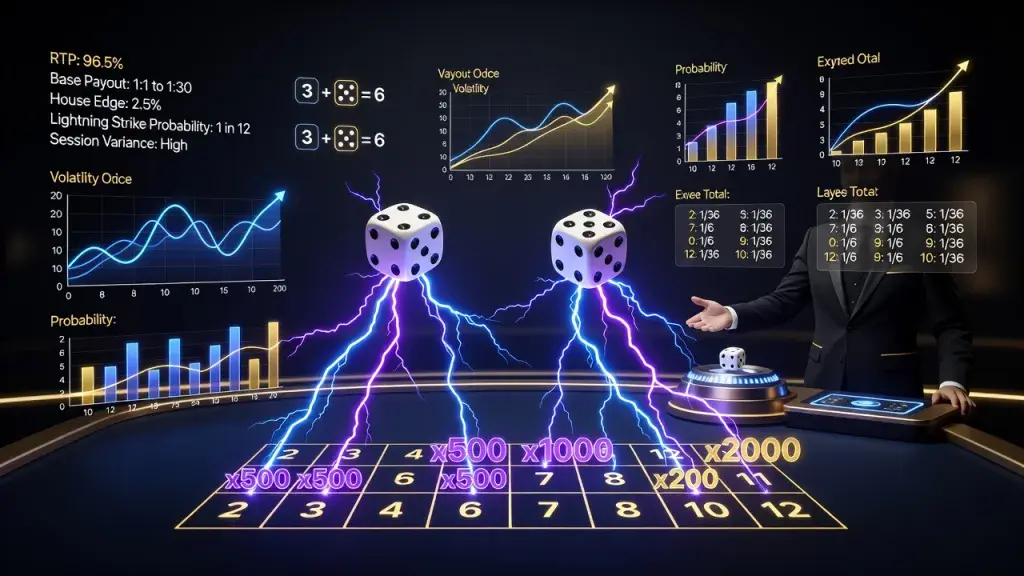
Roll a pair of dice a thousand times under a bolt of electrified multipliers, and the math behind those rolls will tell you far more about your long-term chances than any single winning streak ever could. Lightning Dice, the live casino title that pairs simple dice mechanics with random lightning-strike multipliers, has built a following precisely because its payout structure looks straightforward but hides real statistical depth once you start comparing bet types.
Most players approach the game backwards. They chase the multiplier strikes without understanding what those strikes actually cost them in terms of house edge on other bets. Before placing real wagers, it helps to study the published lightning dice rtp figures and how they shift depending on which numbers you back. For a closer look at the live version and its current payout terms, the game page at lightning dice rtp lays out the specifics worth reviewing before your first session. Understanding those numbers changes how you size bets and which combinations you avoid entirely.
This piece breaks down the return figures, the odds behind each dice total, the payout rate structure across bet types, and the volatility profile that determines whether your bankroll will swing wildly or hold steady over a night of play.
What Lightning Dice Actually Is
Core Game Mechanics
Lightning Dice is a live-dealer game built around two standard six-sided dice, generating totals from 2 to 12. Players bet on which total will appear, similar in spirit to a simplified craps or sic bo variant, but stripped down to a single round of dice combined with electronic multiplier effects. A live host or automated dice-shaker produces the roll, and results display instantly on the betting grid.
The Lightning Multiplier Feature
Before each round, the system randomly assigns multipliers - sometimes reaching into the hundreds - to two to five numbers on the board. If the dice land on a number carrying a lightning multiplier, and you bet on it, your payout multiplies accordingly. This mechanic is the game's signature draw and the main reason its payout behavior differs from flat-odds dice games.
Why Structure Matters for Strategy
Because multipliers are assigned randomly each round rather than tied to specific numbers permanently, no single total is inherently "luckier." Betting patterns based on past rolls hold no statistical weight here - each round resets independently. Recognizing this prevents the common mistake of chasing numbers that "haven't hit in a while."
Lightning Dice RTP Explained
Defining Return to Player in This Context
Lightning dice RTP refers to the theoretical percentage of all wagered money that the game returns to players over an extended number of rounds. It's a long-run average, not a promise for any single session. A game advertising a 96.5% RTP, for example, is expected to return that share of total wagers across millions of rounds, with the remainder representing the house's structural advantage.
How the Multiplier Feature Affects Return Figures
What makes lightning dice return to player calculations more complex than standard dice games is the multiplier layer. Base payouts on dice totals already reflect a house edge, but the lightning multipliers inject variable bonus payouts into the mix. Providers calculate an aggregate lightning dice RTP that blends the base game return with the statistical contribution of the multiplier feature, since multipliers hit with a known probability and add measurable value over time.
Comparing RTP Across Bet Types
Not every number on the board returns the same percentage. Totals near the middle of the distribution - 6, 7, and 8 - appear more frequently due to combinatorics, so their base payout is lower per hit. Extreme totals like 2 or 12 pay far more per win but land far less often. The blended lightning dice RTP accounts for this imbalance, but individual bet choices still carry different effective returns depending on how often lightning strikes land on frequently versus rarely occurring numbers.
- Mid-range totals: higher hit frequency, lower base payout multiplier
- Extreme totals (2, 12): lower hit frequency, significantly higher base payout
- Lightning-boosted numbers: temporary payout spikes regardless of base frequency
Understanding Lightning Dice Odds
The Probability Behind Each Dice Total
Two dice produce 36 possible combinations. A total of 7 can be formed six different ways, making it the most probable outcome, while totals of 2 and 12 can only be formed one way each, making them the rarest. This distribution is fixed by mathematics and never changes, regardless of what the lightning feature does on top of it.
How Odds Translate Into Payout Multipliers
Game designers set base payout multipliers inversely to probability. Because rolling a 7 is common, its base payout multiplier is modest. Because rolling a 2 or 12 is rare, the base multiplier is substantially larger. This inverse relationship is standard across dice-based casino games and forms the backbone of lightning dice odds before any lightning strikes are factored in.
Reading the Odds Table Correctly
Players who misread the odds table often overvalue high-multiplier bets on rare totals, assuming a big number means a big edge. In reality, the higher payout compensates for lower frequency - the underlying expected value per bet, before lightning bonuses, is designed to sit close to the same house-favored margin across most totals.
Lightning Dice Payout Rate Breakdown
Base Payouts by Dice Total
The lightning dice payout rate structure assigns fixed multipliers to each total based on its probability. Totals of 2 and 12 typically carry the highest base multipliers on the board, while 7 sits at the lowest since it appears most often. Numbers between these extremes scale progressively, creating a symmetrical payout curve mirroring the probability curve.
How Lightning Strikes Alter Effective Payouts
When a lightning multiplier lands on a number you've backed, your payout for that round multiplies well beyond the base rate - sometimes dramatically. Because these strikes are random and not weighted toward any specific total, every number on the board has an equal theoretical chance of being electrified in a given round, even though the base payout for hitting that number remains unchanged.
Session-Level Payout Variance
Over a short session, actual payout results can deviate substantially from the theoretical rate. A player might hit two lightning strikes in ten rounds and walk away well ahead, or see none in fifty rounds and land below the expected return. This variance is normal and expected in any game with a bonus multiplier layered over base probability.
Lightning Dice Game Volatility
What Volatility Means in This Format
Lightning dice game volatility describes how much individual outcomes swing away from the average return. A low-volatility game produces small, frequent wins with minimal drama. A high-volatility game produces long dry stretches punctuated by large payouts. Lightning Dice sits toward the higher end of this spectrum precisely because of its multiplier mechanic.
Why the Multiplier System Increases Volatility
Base dice betting alone would produce moderate volatility, similar to other even-money and proposition dice games. The lightning multiplier layer amplifies this significantly. A single well-timed strike on a low-probability number can produce a payout many multiples larger than a typical winning round, pulling the entire volatility profile upward.
Managing Bankroll Against High Volatility
Players comfortable with high-volatility formats typically size bets smaller relative to their total bankroll, accepting longer stretches without a major hit in exchange for the chance at an outsized multiplier round. Flat, consistent bet sizing across many rounds tends to smooth out the experience better than escalating bets after losses, since no betting pattern changes the independent probability of each new roll.
Practical Tips for Playing With RTP and Odds in Mind
Choosing Bets Based on Risk Tolerance
Players seeking steadier, more frequent returns tend to favor mid-range totals like 6, 7, and 8, accepting smaller payouts in exchange for more consistent hits. Those chasing bigger swings gravitate toward extreme totals, accepting long losing stretches for the chance at a large multiplier-boosted payout.
Reading Live Multiplier Patterns Without Overreacting
It's tempting to track which numbers received lightning strikes in recent rounds and bet accordingly. This impulse should be resisted - each round's multiplier assignment is independent of prior rounds, and no historical pattern predicts future strikes.
Setting Realistic Session Expectations
Given the elevated volatility, players benefit from treating each session as a small sample rather than expecting results to mirror the long-run theoretical rate. Setting a loss limit and a win target before playing helps counteract the emotional pull of chasing a lightning strike that never lands.
Frequently Asked Questions
What is a good RTP for a dice-based live casino game like this?
Live dice games with bonus multiplier features typically publish RTP figures in the mid-to-high 90s percent range. Anything above roughly 95% is considered competitive within this category, though the exact figure varies by operator and by which specific bet is placed.
Does the lightning multiplier change the underlying dice odds?
No. The physical probability of rolling any given total remains fixed by dice mathematics. The multiplier only affects the size of the payout when a lightning-boosted number happens to hit, not the likelihood of that number appearing.
Why do some numbers pay more than others?
Payouts scale inversely with probability. Numbers like 2 and 12 occur rarely, so they carry higher base multipliers to compensate. Numbers like 7 occur frequently, so their base payout is comparatively modest.
Is Lightning Dice suitable for players with a small bankroll?
It can be, provided bet sizes stay small relative to the total bankroll. Because the game carries elevated volatility, undersized bankrolls risk depletion during a dry stretch before a lightning strike arrives to offset losses.
Can betting on multiple numbers at once improve my chances?
Spreading bets across several totals increases the frequency of small wins but does not change the overall house-favored return built into the game. It simply redistributes risk across more outcomes rather than improving the mathematical edge.
How often do lightning multipliers typically appear on the board?
Each round, a set number of totals - usually between two and five - receive a random multiplier before the dice are rolled. Whether your chosen number is among them is entirely random and independent from round to round.